
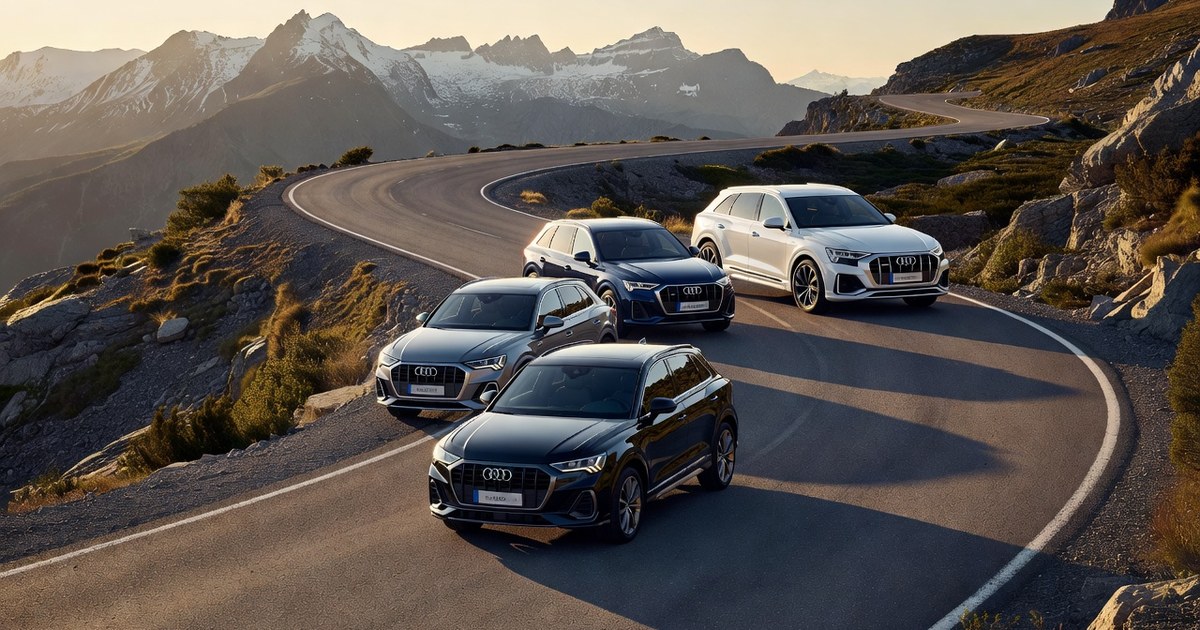
For most of the last decade, the Audi SUV range had a clear ceiling. The Q7 sat at the top, and buyers who wanted something larger looked elsewhere. That gap is now closed. With the arrival of the Q9, Audi has a full-size three-row SUV for the first time, and the lineup finally runs from a compact urban crossover all the way to a 209-inch flagship.
The change is more consequential than one new nameplate. Audi has spent the past two years replacing nearly every SUV in the range, moving its gasoline models onto a new architecture while building its electric SUVs on a separate platform designed specifically for that job. The result is a lineup that is broader and more internally consistent than it has ever been, but also one that takes a minute to map.
Here is how it actually sorts out, and how to figure out where you belong in it.
The Gasoline Range: Q3, Q5, Q7, Q8, and Now Q9
Audi's combustion SUVs are increasingly built on a shared foundation called Premium Platform Combustion, or PPC. The Q5 and the new Q9 both use it. That matters to buyers because it means shared engineering priorities, a common infotainment architecture, and consistent driving character as you move up the range.
The Q3 anchors the entry point. Fully redesigned for 2026, it is the compact option for buyers who want the Audi experience in a footprint that suits dense cities and tight parking. The redesign brought sharper exterior surfacing, an 11.9-inch digital instrument cluster, and a 12.8-inch infotainment touchscreen, and it remains the most maneuverable SUV in the range.
The Q5 is the volume center of gravity and has been one of the best-selling luxury SUVs in the United States for over a decade. Every 2026 Q5 and Q5 Sportback in the US uses a 2.0-liter TFSI four-cylinder with a 48-volt mild hybrid system, producing 268 horsepower and 295 lb-ft of torque, paired with a seven-speed S tronic dual-clutch and standard quattro. Cargo runs 27.6 cubic feet behind the rear seats and 56.9 with them folded. Pricing starts around $54,090, with the 368-horsepower SQ5 opening near $66,095.
The Q7 is the established three-row choice, seating seven with a third row best understood as occasional-use space rather than a place adults will want to spend two hours. It carries into 2026 with equipment updates, including standard all-wheel steering and OLED taillights on the 55 Prestige.
The Q8 remains the style-forward alternative to the Q7, trading the third row and some cargo volume for a coupe-inspired roofline and a lower, wider stance, with the SQ8 and RS Q8 covering the performance end.
The Q9: What Actually Changed at the Top
The 2027 Q9 is the largest production vehicle Audi has ever sold, and it was engineered with the US market as the primary target. Audi CEO Gernot Döllner told Car and Driver that a full-size SUV "was the loudest request from our dealers" in North America, and roughly two-thirds of Q9 production is expected to come here.
The dimensions tell the story: 209.1 inches long on a 123.6-inch wheelbase, nearly ten inches longer than the Q7 with almost six additional inches between the axles. Most of that goes to the third row, which Audi says is sized for full-size adults rather than children. Cargo capacity is 19.3 cubic feet behind the third row, 50.0 behind the second, and 87.7 with both rows folded. Towing is rated at 7,700 pounds.
For North America, the Q9 uses a twin-turbocharged 2.9-liter V-6 making 429 horsepower and 442 lb-ft, paired with an eight-speed automatic, quattro, and a 48-volt mild hybrid system. The SQ9 steps up to a twin-turbocharged 4.0-liter V-8 rated at 591 horsepower. Air suspension and rear-axle steering are available, which is what keeps a vehicle this long from feeling composed in a parking structure. First US deliveries are expected in the fourth quarter of 2026.
The Electric Range: Q4 e-tron and Q6 e-tron
Audi's electric SUVs are a parallel lineup rather than converted versions of the gasoline cars, and the naming follows the same size logic. The Q4 e-tron is the compact entry and the most accessible EV in the range, offered as a conventional SUV and as a Sportback. For 2026, it adds Park Assist Plus, a 360-degree camera, and a Sonos audio system as standard on Premium Plus, with a Vision package available on the higher-output Q4 55 models.
The Q6 e-tron is the more significant vehicle. It launched on the Premium Platform Electric architecture with an 800-volt system, which is the specification that determines how much of your charging stop is spent waiting, and it supports DC fast charging at up to 270 kW. Rear-drive single-motor versions make 322 horsepower, dual-motor quattro versions reach 456, and the SQ6 e-tron produces up to 510. Anyone weighing an electric SUV should read the Audi Q6 e-tron range and charging specs against their actual weekly mileage, because range on a spec sheet and range on a January highway are different numbers.
Above the Q6 e-tron, the picture is still developing. Audi has confirmed that a larger electric SUV is in the works to sit at the top of the range, but it has not been detailed for the US market, so for now the Q4 and Q6 carry the electric lineup.
How to Choose: A Practical Framework
Start with the third row, because it is the question that eliminates the most options fastest. If you need three rows every week with adults or teenagers in the back, the Q9 is the vehicle in this lineup built for it. If you need one occasionally for children, the Q7 does the job and costs considerably less. Working through an Audi Q7 vs Q9 size comparison makes those third-row and cargo tradeoffs concrete before you commit to the larger footprint.
Then look at your charging situation, not your feelings about electric cars. Home charging turns an EV into the most convenient vehicle you have ever owned. Without it, a mild hybrid gasoline model like the Q5 is the more sensible choice.
Finally, be realistic about size. The Q9 is a genuinely large vehicle at over 209 inches. In a suburban driveway, that is a non-issue. In a city with a 1960s parking garage, it is worth measuring before you sign.
Across the range, ownership terms are the same: a four-year, 50,000-mile limited warranty, three years or 30,000 miles of complimentary scheduled maintenance under Audi Signature Care, a 12-year corrosion perforation warranty, and four years of roadside assistance. That consistency is part of what makes cross-shopping within the lineup straightforward.
The Audi SUV range is no longer a ladder with a missing top rung. It is a complete grid, sorted by size on one axis and powertrain on the other, and the right vehicle is usually found by answering two honest questions about seats and charging.